Inky
Inky is a prototype of an AI writing companion that integrates AI in a way that helps students develop their own critical thinking skills, find their own voice, and form their own point of view.
Try the live demo here (note that it's mocking the API calls, to save on costs).
Initial POC hacked together by mathurah and anna!
With the proliferation of AI, students can simply paste prompts into a model and have them write an essay for them. The reality is that we can't stop students from using AI completely, but we can build interfaces that help them leverage it in a more educational way.
It's so important for students to develop the muscles of:
- Critical thinking
- Finding their own unique voice: how they write that's uniquely them
- Developing their own point of view
With Inky, students converse with AI to develop their own point of view and key points, write a complete first draft themselves from start to finish, then revise with AI feedback in the comments, talking back and forth to improve their writing.
How it works
Inky takes students through the entire writing lifecycle:
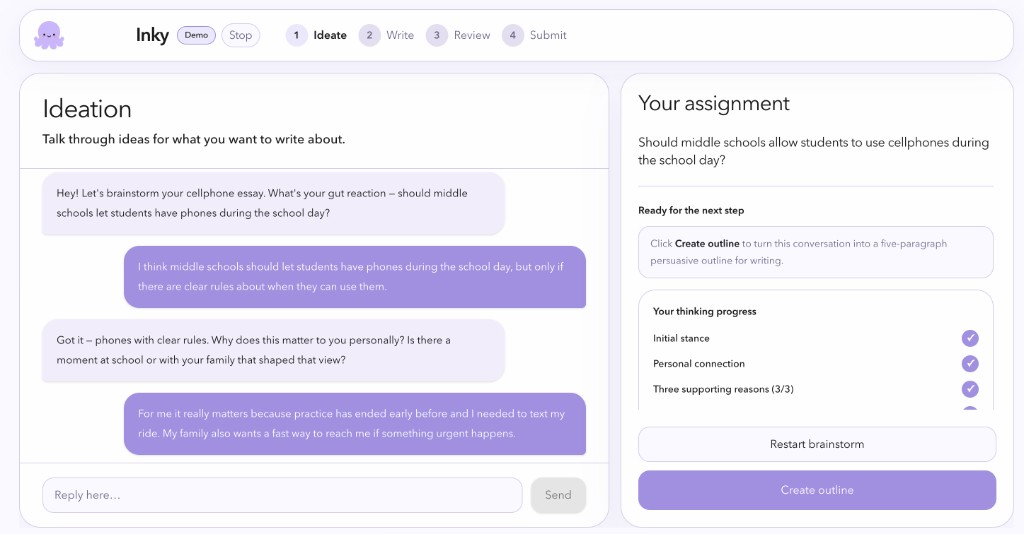
- Ideation: talk through ideas to land on a thesis and supporting points
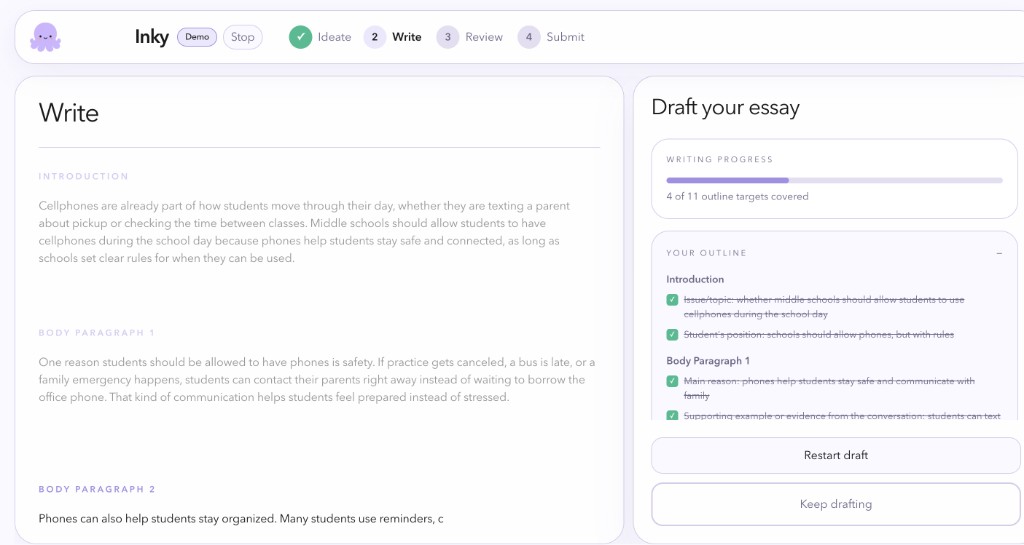
- Writing: draft section by section, with coverage checks along the way
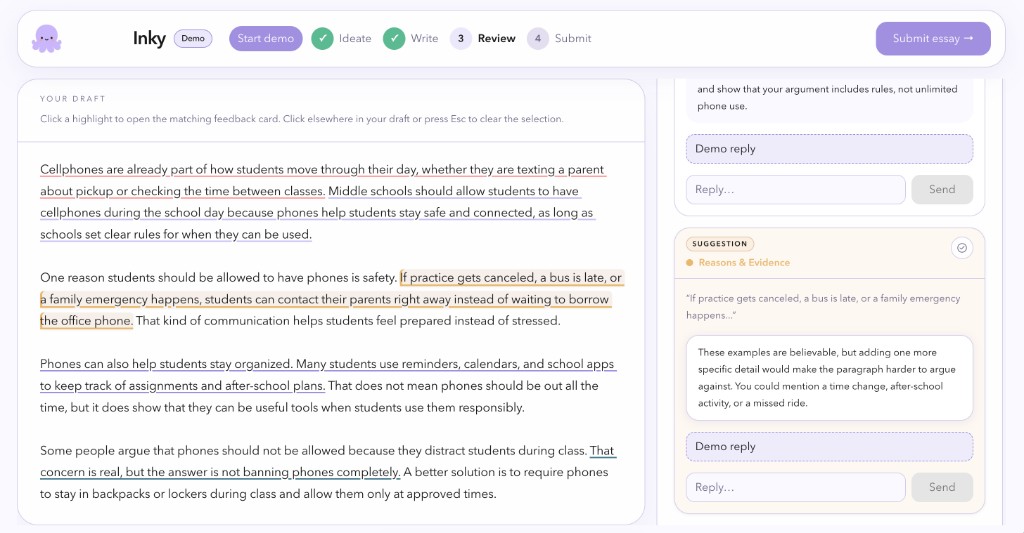
- Revision: get feedback anchored to specific passages and rubrics
- Submit: export the finished draft
Step one: Ideation
The goal of ideation is to use conversation to help students share their initial point of view. The chat asks probing questions so they reflect and form an opinion from their own observations and lived experiences.
The AI can also help them research sources that support the claims they're making. As they talk, Inky starts assembling an outline from their key points, so the brainstorm becomes structure without handing over the thinking.
Step two: Write
After ideation, Inky turns the conversation into an outline and asks the student to write the full first draft themselves, section by section, from start to finish. A coverage checklist tracks which outline points they've hit, so they stay on track without the AI writing any of the prose for them. That's where they build their own voice: sentence by sentence, in their own words.
Step three: Revision
Once the draft is done, Inky reviews it against the assignment and highlights specific passages with feedback: what's working, and where to push further. Most AI writing tools dump a wall of generic notes. Here it feels closer to a dynamic Google Docs comments experience: feedback is anchored to specific sentences, and students can ask clarifying questions right in the comment thread. Teachers can also set rubrics for the agent to calibrate against, so students learn through the process and iterate on their own writing.
What's next
This is just a fun proof of concept. I love writing myself (here's my blog) and was curious how AI is reshaping how students learn to write. If you're thinking about education, writing, or AI interfaces that help people think instead of skipping the thinking, I'd love to chat.